Compression Socks and Insurance: Medicare, HSA, FSA and Prescriptions
The short answer
- Medicare: Part B covers compression garments for lymphedema when your doctor orders them. Everyday compression socks for tired legs are not part of this benefit.
- HSA and FSA: compression socks can qualify as a medical expense. Many plans want a Letter of Medical Necessity from your doctor, and some only accept firmer levels.
- Private insurance: it depends on your plan. Call the number on your card before you buy.
- Prescription: you don't need one to buy most compression socks in the US. You may need a doctor's order or letter to get them paid for.
Does Medicare cover compression socks?
Since January 1, 2024, Medicare Part B covers lymphedema compression treatment items. This benefit came from Section 4133 of the Consolidated Appropriations Act, 2023, the law many people know as the Lymphedema Treatment Act.
Here is what Medicare.gov and CMS say about it:
- You must have lymphedema, and your doctor or other health care provider must order the items.
- What is covered: standard and custom-fitted gradient compression garments, compression wraps with adjustable straps, bandaging supplies, and accessories such as donning aids, linings and zippers.
- How many: up to 3 daytime garments per affected body part every 6 months, and 2 nighttime garments per affected body part every 2 years. Replacements are covered if items are lost, stolen, damaged beyond repair, or if your limb size changes.
- Your cost: after you meet the Part B deductible, you pay 20% of the Medicare-approved amount.
- Where to get them: only from suppliers enrolled with Medicare as medical equipment (DMEPOS) suppliers.
If you don't have lymphedema, this benefit doesn't apply. Medicare has also paid for certain compression garments when they are used as a surgical dressing on a wound, under separate rules. Ask your doctor whether that applies to you.
If you have a Medicare Advantage plan, call the plan and ask what it covers.
Do you need a prescription for compression socks?
In the US, you can buy compression socks at many levels without a prescription. Milder levels such as 15-20 mmHg are sold in stores and online.
A prescription becomes important in two cases:
- Firmer levels. Truform's compression chart, for example, recommends a prescription for 20-30 mmHg and higher. Your doctor should decide whether you need that much pressure. Our guide to what mmHg means explains the levels.
- Getting them paid for. Medicare requires a doctor's order for lymphedema garments. HSA and FSA plans often ask for a Letter of Medical Necessity. Private insurers that cover them may want a prescription and a diagnosis on file.
Even if you don't need a prescription, it is a good idea to talk to your doctor first if you have a health condition. Some people should not wear compression at all. See who should not wear compression socks.
Are compression socks HSA or FSA eligible?
They can be, but it depends on the reason you need them and on your plan.
The IRS lets HSA and FSA money pay for "medical care." IRS Publication 502 describes medical expenses as the costs of diagnosis, cure, mitigation, treatment or prevention of disease. It also says that expenses that are merely beneficial to general health don't count. Publication 969 ties qualified HSA expenses to the same tax code definition of medical care.
The IRS does not publish a list of eligible products, so plan administrators make their own rules. Two real examples show how much they vary:
- FSAFEDS (the FSA program for federal employees) lists compression or anti-embolism socks at 10-20 mmHg as eligible with a Letter of Medical Necessity signed by your doctor plus a detailed receipt. At 20-30 or 30-40 mmHg, a detailed receipt is enough.
- Lively, an HSA and FSA provider, says compression socks rated 30-40 mmHg or above that are used to treat a medical condition are eligible for FSA, HSA and HRA accounts. It says they are not eligible with a limited-purpose FSA or a dependent care FSA.
So a 15-20 mmHg sock may be accepted by one plan with a doctor's letter and turned down by another. Ask your administrator before you buy, and keep your receipt.
What a Letter of Medical Necessity includes
A Letter of Medical Necessity (LMN) is a note from your doctor explaining why you need an item for a medical condition. Each plan has its own form, but FSAFEDS lists what it needs, and it is a good model:
- Patient name, and the account holder's name and employer
- The medical condition
- The recommended treatment, including how often
- How long the treatment will last
- The provider's name, signature and the date
FSAFEDS says a letter missing this information may be denied, and that you need a new letter if treatment goes past the dates on the old one. Ask your plan for its form before your doctor's visit so you can get it signed in one trip.
Does private insurance cover compression stockings?
Coverage depends on your plan. The only way to know is to call the member services number on your card and ask:
- Do you cover compression stockings or socks? Under which benefit, such as medical equipment or supplies?
- What diagnosis and what mmHg level do you require?
- Do I need a prescription, a prior approval, or a specific supplier?
- How many pairs do you cover, and how often?
- What will I pay after my deductible?
Write down the name of the person you spoke with and the date.
What this means for our socks
We want to be clear about what we can and can't do.
- We don't bill insurance or Medicare. You pay us directly.
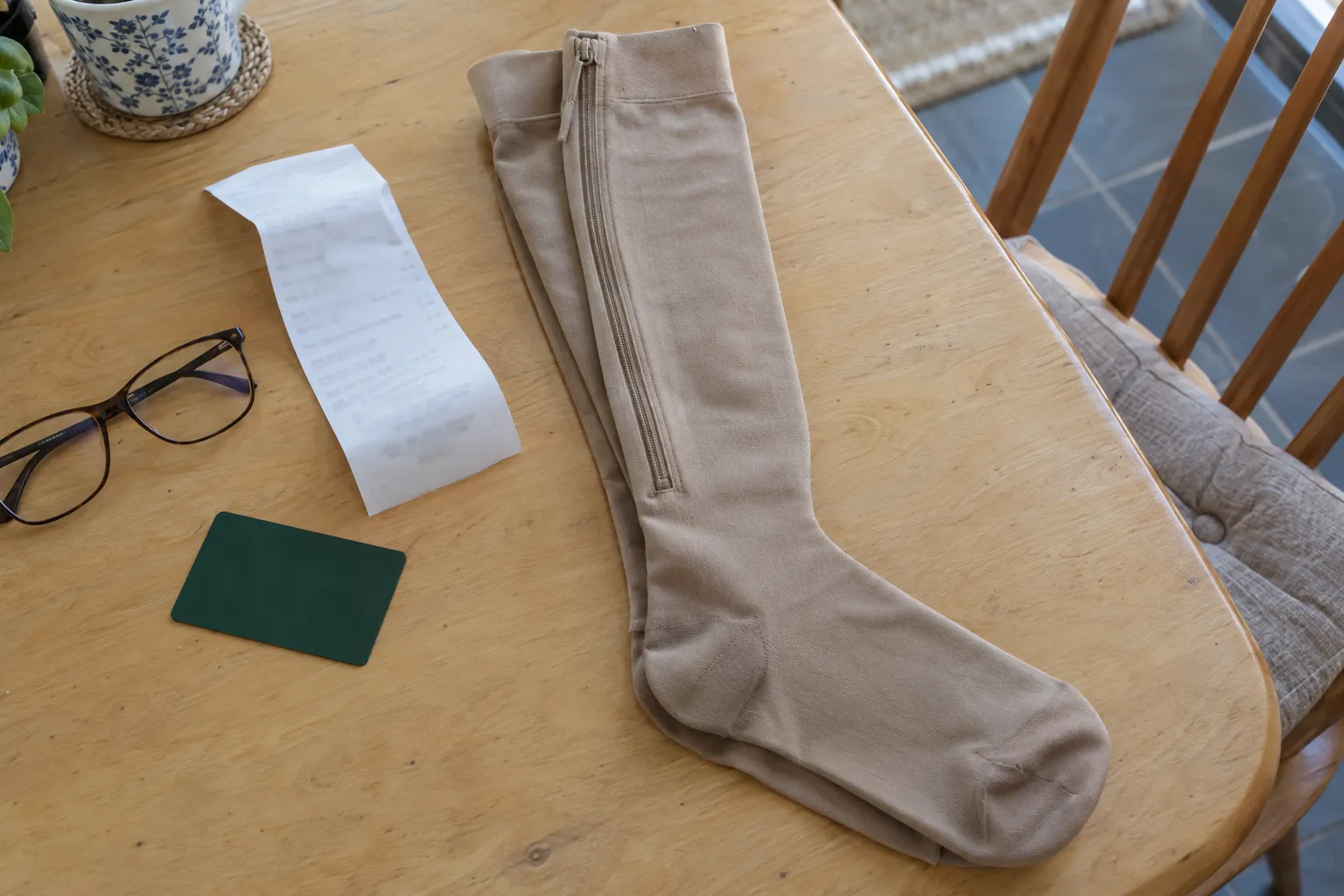
- Your receipt shows the item you bought, including the product name. You can send it to your plan if you file a claim.
- We can't tell you whether your plan will pay. Your HSA or FSA administrator decides that. Our socks are 15-20 mmHg, a level many plans only accept with a Letter of Medical Necessity, and some plans don't accept it at all.
Our closed-toe and open-toe Zip-Up Compression Socks cost $29 for one pair, with lower prices per pair in multi-packs, and shipping is free on two or more pairs. Details are on our shipping page. If they don't work out, our 90-day money-back guarantee covers socks you have worn and washed.
Check with your doctor before wearing compression socks if you have peripheral arterial disease, poor circulation in the legs, heart failure, or reduced feeling in your feet. If you can't feel your feet well, you may not notice when a sock is too tight.