What Does mmHg Mean in Compression Socks? 15-20, 20-30 and 30-40 Explained
What does mmHg mean?
mmHg is short for millimeters of mercury. It's the same unit used for blood pressure readings. Compression sock makers use it to rate how hard a sock presses on your leg.
A range like 15-20 mmHg means the sock is designed to press on your ankle at somewhere between 15 and 20 mmHg. A higher number means a firmer squeeze.
One thing to know up front: Cleveland Clinic notes that there is no standard scale for rating compression stockings. Countries even use different class systems. In one comparison of European standards, a British class 1 stocking covers 14 to 17 mmHg, while a German class 1 covers 18 to 21 mmHg. That's why it's best to look at the actual mmHg numbers instead of words like "light" or "support" on the package.
Graduated compression socks: why the ankle number matters
Graduated compression socks are tightest at the ankle and get gradually looser up the leg. The mmHg number on the package is the pressure at the ankle. Higher up the calf, the pressure is lower.
That step-down is the point. A review in the Canadian Medical Association Journal explains that pressure easing from the ankle upward helps keep blood moving toward the heart instead of pooling in the foot. In medical stockings, the pressure can drop by as much as 80% between the ankle and the top of the thigh, depending on the design and its purpose.
Graduated socks are different from the anti-embolism stockings, often called TED hose, used for people in hospital beds. Our comparison of compression socks vs stockings vs TED hose explains the difference.
Compression levels compared: 8-15, 15-20, 20-30 and 30-40 mmHg
| Level | Pressure at the ankle | Often used for | How people usually get them |
|---|---|---|---|
| Mild | 8-15 mmHg | Light everyday support | Over the counter |
| Moderate | 15-20 mmHg | Long hours standing or sitting, travel, pregnancy with your provider's OK | Usually over the counter |
| Firm | 20-30 mmHg | Varicose veins, swelling that lingers, chronic vein problems | Often suggested by a doctor; some sources say a prescription is needed |
| Extra firm | 30-40 mmHg | Venous leg ulcers, lymphedema, more severe vein disease | By prescription, ideally with a professional fitting |
Cleveland Clinic groups the common levels as mild (8-15 mmHg), moderate (15-20 mmHg), firm (20-30 mmHg) and extra firm (30-40 mmHg). It says extra-firm socks are usually only available by prescription and should only be used under a doctor's supervision.
Prescription rules vary by source. Cleveland Clinic says low-compression stockings under 20 mmHg are sold over the counter and that stockings rated 20 mmHg or higher require a prescription. Stanford Health Care sets its cutoff lower, at above 15 mmHg. Either way, check with your provider before choosing a level if you have a health condition.
15-20 mmHg vs 20-30 mmHg: what is the difference?
15-20 mmHg is where many people start. Cleveland Clinic says low-compression stockings may be a good choice if you stand or sit for long periods of time or are pregnant, and recommends talking to your provider before buying them.
20-30 mmHg is a step firmer. A 2019 review in American Family Physician notes that 20-30 mmHg is the typical recommendation for varicose veins, even though research hasn't settled the best pressure.
What do studies show in healthy people? In a study of 58 working adults, both levels reduced leg swelling over a workday, and the 20-30 mmHg stockings reduced it more. In a study of security guards on long standing shifts, guards in regular socks showed more swelling, fatigue and discomfort after work, while guards in 15-20 or 20-30 mmHg stockings showed no significant changes.
Firmer isn't automatically better for you. Firmer socks are harder to put on, and a sock that stays in the drawer does nothing. The CMAJ review lists pain, discomfort and difficulty putting stockings on among the common reasons people stop wearing them.
What 20-30 mmHg and 30-40 mmHg compression socks are for
What does 20-30 mmHg mean?
A 20-30 mmHg sock presses on the ankle at 20 to 30 millimeters of mercury, easing off higher up the leg. The CMAJ review calls this range medium compression. A doctor may suggest it for varicose veins, swelling that doesn't settle with lighter socks, or chronic venous insufficiency. If you have varicose veins, ask your doctor which level fits your situation.
30-40 mmHg compression socks
This is a strong level. American Family Physician reports that for healing venous leg ulcers, compression of at least 20-30 mmHg is recommended and 30-40 mmHg is preferred. The CMAJ review also notes evidence that 30-40 mmHg stockings are effective in lymphedema. At this level, get a prescription and a professional fitting, and wear them as your doctor directs.
What strength compression socks do I need?
Start with why you want them:
- Tired, achy legs or mild end-of-day swelling from standing, sitting or travel: 15-20 mmHg is a common starting point. See our guide to compression socks for tired, aching legs.
- Varicose veins, swelling that lingers, or a vein condition your doctor has diagnosed: ask your doctor whether 20-30 mmHg makes sense for you.
- Leg ulcers, lymphedema, a past blood clot, or severe swelling: this is your doctor's call. Get a prescription and a proper fitting.
If you're unsure, starting at a lower level is reasonable. The CMAJ review notes that many problems with compression stockings can be solved by refitting them or lowering the compression.
Check with your doctor before wearing compression socks if you have peripheral arterial disease, poor circulation in the legs, heart failure, or reduced feeling in your feet. If you can't feel your feet well, you may not notice when a sock is too tight.
How tight should compression socks be?
They should feel snug, clearly firmer than a regular sock, with the most pressure at your ankle and less up your calf. MedlinePlus says compression stockings should feel tight, with the most pressure around the ankles. Stanford Health Care notes it can take a few days to get used to the pressure.
They should not hurt. Take them off and call your doctor if you notice pain, numbness, tingling, skin color changes or skin damage, or swelling that gets worse.
Watch for bunching too. Rolling, gathering or folding the fabric adds pressure in one spot, like a tight rubber band around your leg. Smooth out wrinkles, and never fold the top down. A knee-high sock should end about two fingers below the bend of your knee.
Fit matters as much as the number
The mmHg rating assumes the sock fits your leg. The CMAJ review notes that the pressure a stocking actually delivers depends on the size and shape of the wearer's legs, along with the fabric and how you move. A sock that is too small for your calf will feel tighter than its rating. One that is too big will feel looser.
Measure the widest part of your calf, ideally in the morning before swelling builds, and match it to the chart in our compression sock size guide. If you fall between sizes, size up.
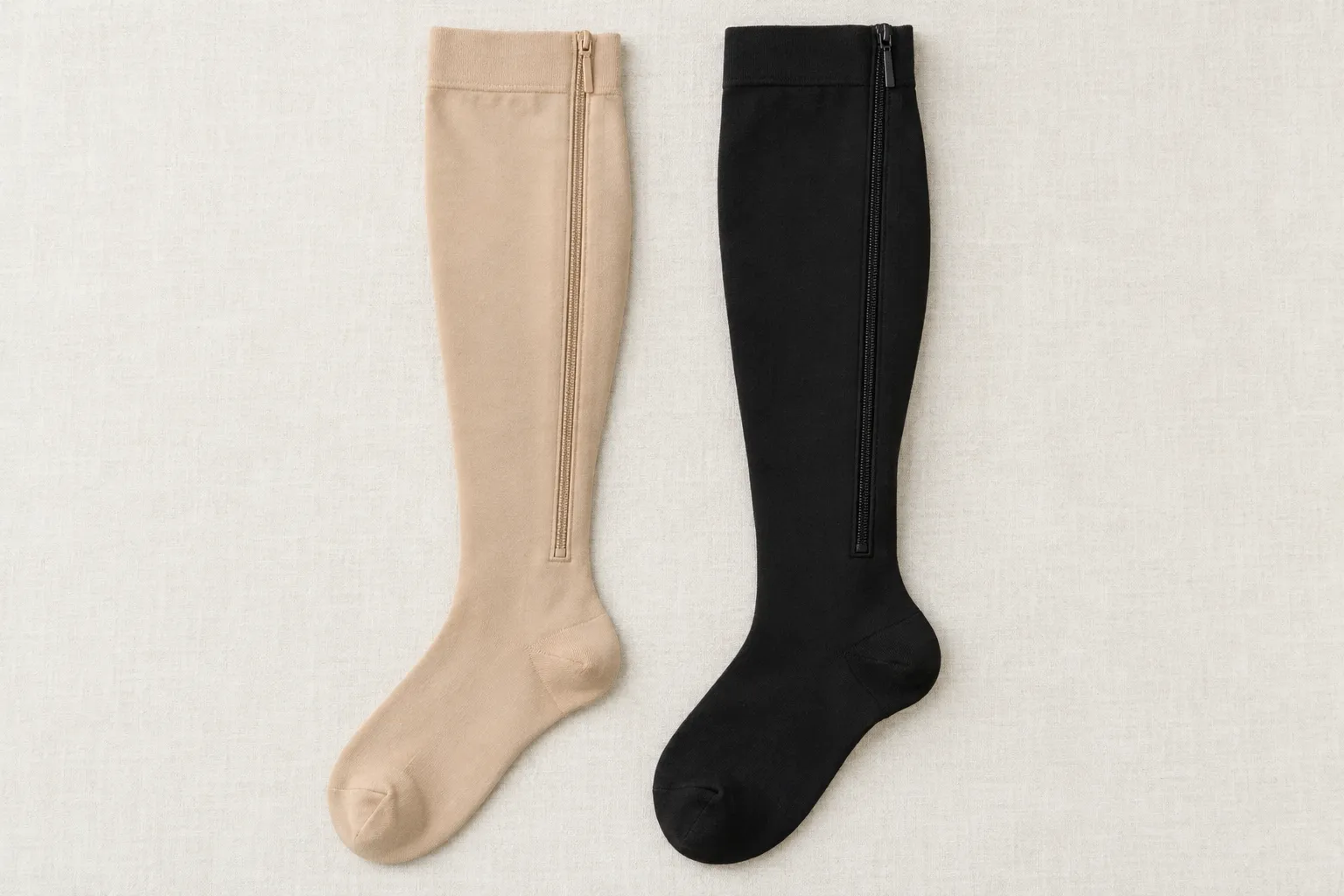
Our closed-toe zip-up compression socks and open-toe zip-up compression socks are graduated 15-20 mmHg and knee-high, in sizes M through 3XL by calf measurement. If you plan to pay with health account funds, read whether insurance, HSA, FSA or Medicare covers compression socks.