What Do Compression Socks Do? How They Work and Who They Help
How do compression socks work?
Your arteries carry blood down to your legs. Your veins have the harder job: carrying it back up to your heart, against gravity. They get help from one-way valves inside the veins and from your calf muscles, which squeeze the veins every time you walk.
When you sit or stand still for hours, or when the valves in your leg veins are weak, blood and fluid can collect in your lower legs. Compression socks push back. Their steady squeeze on the outside of the leg narrows the large veins a little, which helps blood move faster and in the right direction, up toward the heart. The squeeze also helps keep fluid from building up in the tissues of your feet and ankles.
What graduated compression means
Most compression socks use graduated compression. They press hardest at the ankle, and the pressure gradually lightens as the sock goes up the leg. A review in the Canadian Medical Association Journal explains that this gradient helps keep blood flowing upward instead of sliding back down toward the foot. It's also why the ankle feels like the tightest part when you put them on.
Compression strength is measured in millimeters of mercury, written mmHg. Our guide on what mmHg means for compression socks explains the levels and how to choose one.
Compression socks benefits you may notice
According to MedlinePlus and Cleveland Clinic, wearing compression socks or stockings can help with:
- Swelling in the feet, ankles and lower legs, especially after long hours of sitting or standing.
- Aching, tired or heavy legs at the end of the day.
- Blood flow during long trips, when you're seated for hours.
- Symptoms of vein problems such as varicose veins and chronic venous insufficiency, a common condition where the valves in the leg veins don't work as well as they should.
- A lower risk of blood clots in certain situations, mainly after surgery or injury when you're less active, and on long flights.
Many people also simply like how their legs feel in them. As a Cleveland Clinic cardiovascular specialist puts it, to many people they just feel good. If your main concern is tired, aching legs or swollen ankles and feet, our guides go into more detail.
Do compression socks work? What the evidence shows
For some uses the research is strong. For others it's thin. Here's an honest summary.
Long flights: strong evidence
A 2021 Cochrane review looked at trials of airline passengers on flights of at least five hours. It found high-certainty evidence that people who wore compression stockings had a large reduction in symptomless blood clots in the leg, known as deep vein thrombosis or DVT. Leg swelling was also reduced, though the certainty of that finding was low. The trials were too small to show an effect on serious clots. If you fly often, see our page on compression socks for travel.
Swelling from standing or sitting at work: promising
Small studies in healthy workers suggest compression reduces end-of-day leg swelling. In a study of 58 working adults, both 15-20 mmHg and 20-30 mmHg stockings reduced swelling over a workday, with a bigger drop at the higher pressure. In a study of security guards on long standing shifts, guards in regular socks showed more swelling, muscle fatigue and discomfort after work, while guards in either strength of compression stocking did not.
Chronic vein disease: well supported
The CMAJ review concluded that high-quality evidence supports compression stockings for people with chronic venous insufficiency, especially those with venous leg ulcers.
Varicose veins: mixed
A 2019 review in American Family Physician found there isn't enough evidence to say compression stockings treat varicose veins themselves, although they may ease discomfort. Doctors still often suggest them as a first step.
Pregnancy and sports recovery: not settled
The CMAJ review found insufficient evidence to support compression stockings during pregnancy. Cleveland Clinic notes that some studies support a benefit for muscle recovery in athletes, but the evidence is still building.
What compression socks can't do
Compression socks support blood flow. They don't fix the cause of a vein problem, and they are not a treatment for a blood clot you already have. Cleveland Clinic says they may not keep vein conditions from developing, though they can lower risk and ease symptoms. In its words, they aren't a magic bullet.
Warmth, tenderness, pain, swelling or redness in one leg can be signs of a deep vein clot. Don't try to manage that with socks. Get medical care right away.
Swelling in both legs can also come from heart, kidney or other health problems. If your swelling is new, severe or getting worse, see a doctor before you reach for compression.
Who compression socks can help
Compression socks are worth considering if you are:
- On your feet all day, such as nurses, teachers, retail and restaurant workers.
- Sitting for hours at a desk, in a car or on a plane.
- Pregnant and dealing with leg swelling, after you check with your provider. Cleveland Clinic notes that low-compression socks may be a good choice during pregnancy.
- Living with varicose veins or chronic venous insufficiency, usually on your doctor's advice.
- Noticing your ankles swell by the afternoon, once a doctor has checked the cause.
Are compression socks good for you? Risks and side effects
For most people, yes. The CMAJ review describes graduated compression stockings as generally safe, with relatively few complications. Problems usually come from socks that don't fit, socks worn wrinkled or rolled down, or socks worn by someone who shouldn't use them.
- Skin irritation and discomfort, especially in the first few days.
- Marks, blisters or sores from socks that are too tight or bunched. Poorly fitting stockings can cause pressure damage to the skin. In a large trial of about 2,500 stroke patients in the hospital, skin breaks, blisters and ulcers were more common in those wearing thigh-length stockings (5.1%) than in those without them (1.3%).
- Rarely, nerve or soft tissue damage, which Cleveland Clinic lists among the uncommon serious effects.
Take your socks off and call your doctor if you notice pain, numbness, tingling, skin color changes or skin damage, or swelling that gets worse.
Check with your doctor before wearing compression socks if you have peripheral arterial disease, poor circulation in the legs, heart failure, or reduced feeling in your feet. If you can't feel your feet well, you may not notice when a sock is too tight.
For the full list of situations where compression may not be right, read who should not wear compression socks.
How to get the most out of compression socks
- Pick a sensible strength. Cleveland Clinic lists moderate compression as 15-20 mmHg and firm as 20-30 mmHg. Firmer levels are usually chosen with a doctor.
- Get the size right. Measure your calf at its widest point, ideally in the morning before swelling builds. A sock that is too small can dig in, and one that is too big won't squeeze as it should. Our compression sock size guide shows how.
- Wear them during the day. Put them on in the morning before your legs swell, and take them off before bed. Our guide on whether you can sleep in compression socks explains why.
- Keep moving. Walking works your calf muscles, which help pump blood back up your legs.
- Replace them every 3 to 6 months so they keep their squeeze, as MedlinePlus advises.
Where zip-up compression socks fit in
Compression only helps if you wear it, and many people stop. The CMAJ review reports that 30% to 65% of people don't keep wearing graduated compression stockings, and difficulty putting them on is one of the reasons commonly cited.
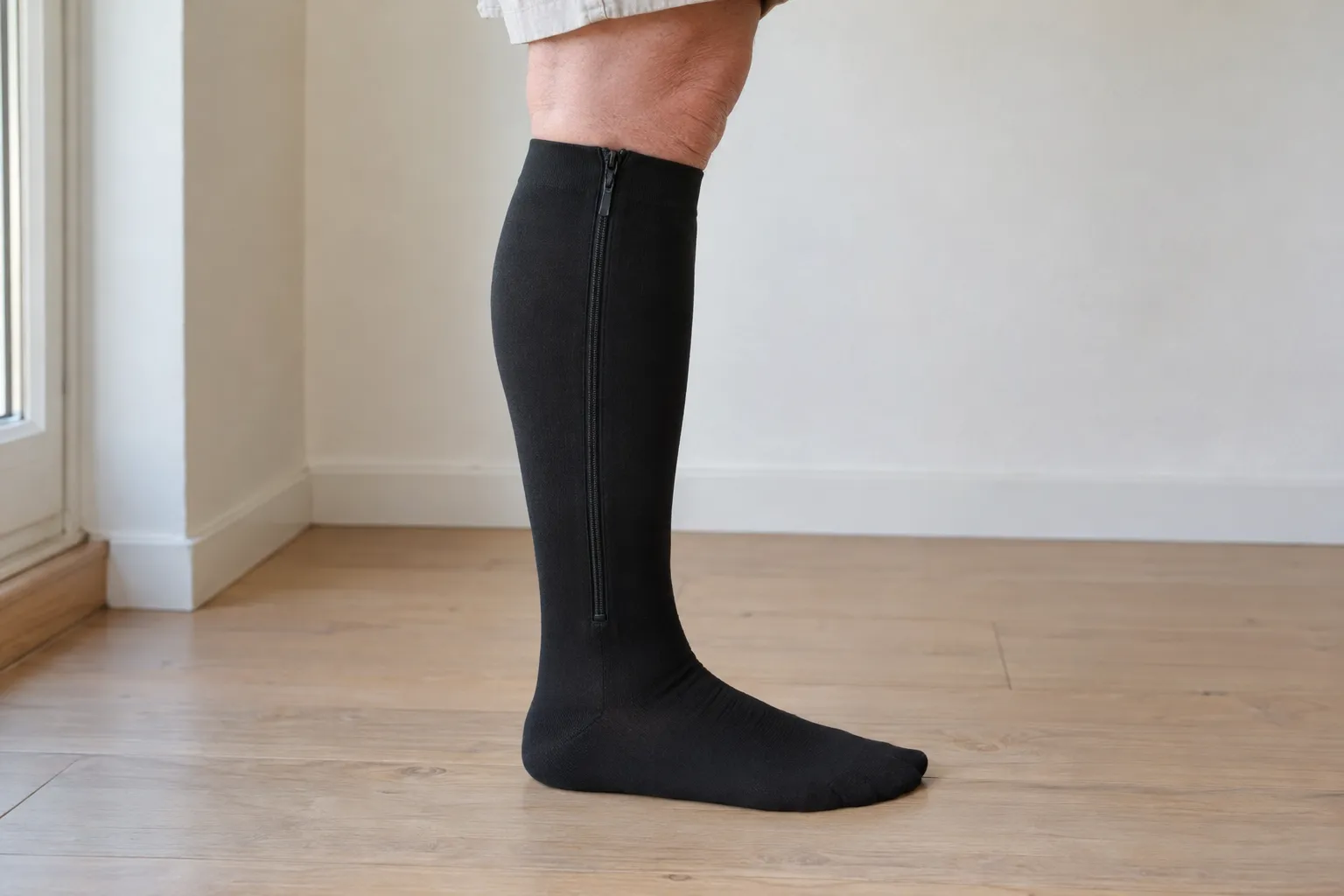
Our zip-up compression socks are knee-high, with graduated 15-20 mmHg compression and a full-length side zipper, so you close them around your leg instead of stretching them over your heel. A soft fabric guard sits behind the zipper teeth. Choose closed-toe zip-up compression socks or the open-toe version. They're made in an FDA-registered facility and come with a 90-day money-back guarantee, even if you've worn and washed them.